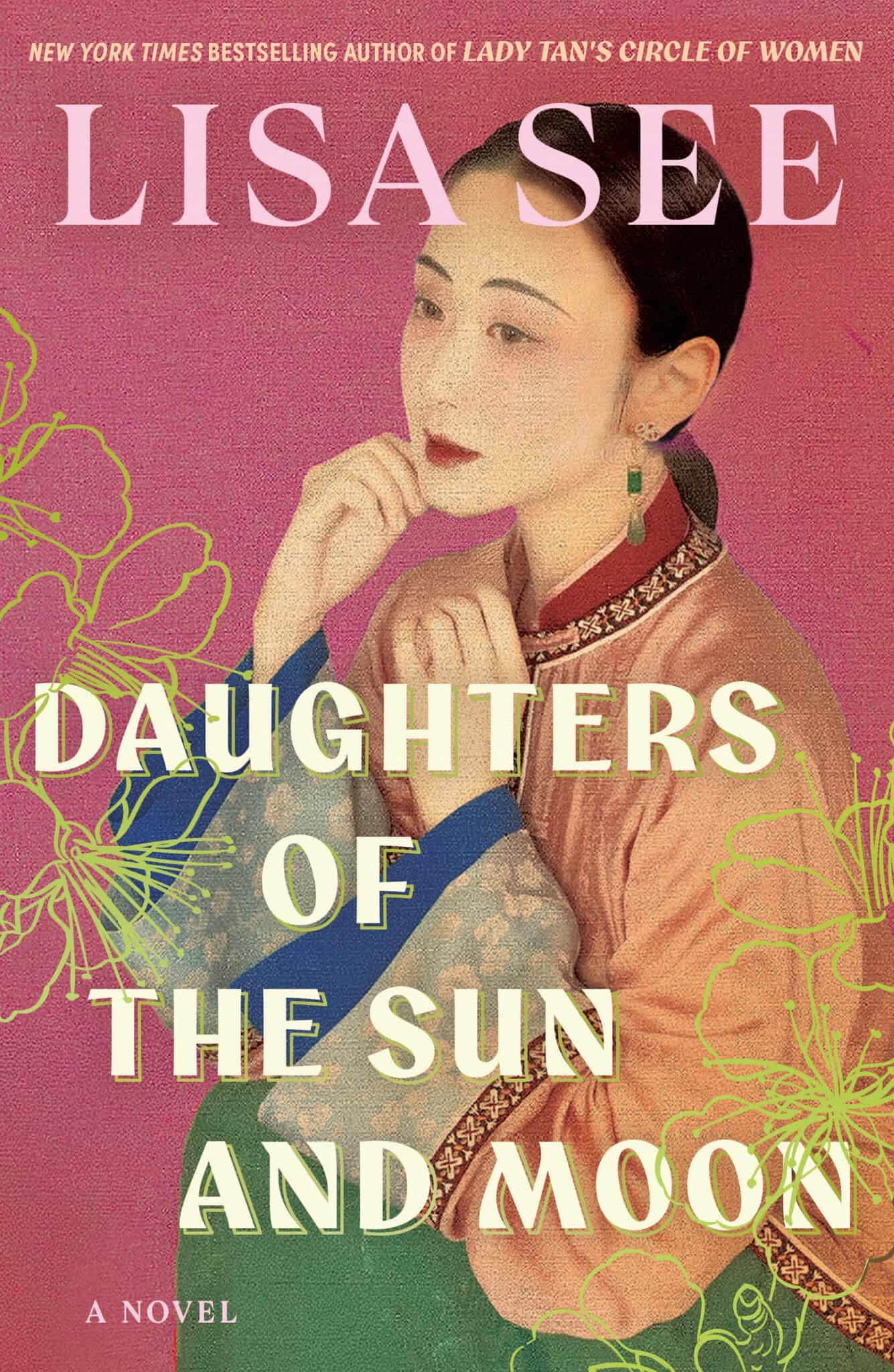
The Four Great Beauties
Throughout time, four women in ancient Chinese history and literature have been held up as exemplars of beauty. Each is credited with influencing distinguished men and the power to “make fish sink and birds fall,” a famous Chinese Idiom.
Xi Shi was considered the most beautiful of the four; lore has it that while washing a veil Xi Shi’s sheer beauty froze the fish in the river where she washed. They sunk to the riverbed. Legend reveals that Xi Shi’s appearance caused an entire kingdom to collapse. Gifted to King of Wu, Xi Shi mesmerized the ruler to the point of distraction; he was eventually conquered by his enemy King of Yue.
The second beauty, Wang Zhaojun lived during the Western Han Dynasty (206 BC-24 AD). Like Xi Shi, her loveliness, too, was powerful. In 33 BC, Wang Zhaojun was traded as a gift to the Chieftain Huhanye of the Xiongnu nomads of Central Asia. Upon sadly leaving her homeland on horseback, Wang Zhaojun encountered a flock of geese, which upon seeing her beauty and hearing the melancholy music she played on her pipa, dropped from the sky.
Diao Chan, the third beauty, has never been proven to be more than a fictional character who appeared in the novel Romance of the Three Kingdoms by Luo Guanzhong. A singer, Diao Chan lived with the official Wang Yun. Wang Yun found her one night praying to the full moon in his garden. A cloud blocked the moon’s glow, as if in reaction to her presence. And Wang Yun declared “Diao Chan is more beautiful than the full moon. The moon felt shame and hid behind the cloud.” (Note that Diao Chan’s fictional basis finds her sometimes replaced by Zhao Feiyan in the listing of great beauties; Zhao Feiyan was an empress during the Han Dynasty.)
The final beauty was known as Yang Guifei or Yang Yuhuan. In a garden, Yang Guifei touches the delightful flowers, only to cause their petals and leaves to curl. Witnessing the event, a maid shared that the flowers had bowed to Yang Guifei’s gorgeous face.
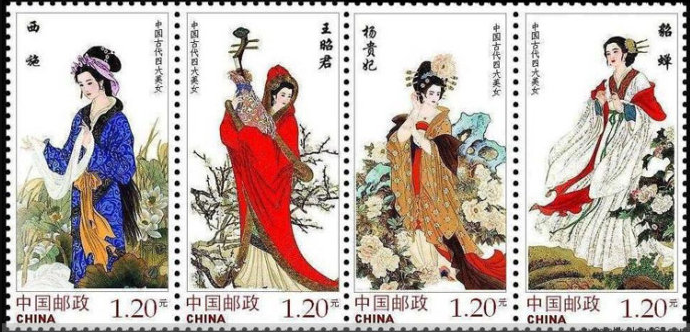
So enduring are these legends that the likeness of the Four Beauties is still referenced today, as seen here on these Chinese stamps.
According to Introduction to Four Ancient Beauties of Ancient China – Culture of Chinese, “Concepts of beauty have changed throughout the various periods of China’s history, but the following 10 characteristics have continuously been considered signs of beauty:
1. Lustrous black hair
2. Hair loosely coiled on the head to create the appearance of greater height
3. Finely shaped black eyebrows. During the Tang Dynasty, many women shaved their eyebrows and they drew eyebrows with pigment
4. Large, bright and expressive eyes
5. Red lips and white teeth. In addition to beauty, this was considered a sign of good health
6. Graceful fingers and arms. A pretty woman was expected to have well-shaped hands, with slim, soft fingers, and fair, fleshy arms
7. Slender waist and fair skin. Throughout history, women have wanted a willowy figure
8. Tiny feet and a light, elegant gait
9. Dressing according to complexion, figure and disposition
10. A fragrant body. It’s said a Concubine Xiang (香妃) of Qing Emperor Qian Long (1711-1799) gave off a natural fragrance.”